


For Your Age: A Compliment With Conditions

We often feel something’s amiss when someone says, “You look good for your age.” Are they sincere? Or is it a backhanded compliment? What do people expect I should look like at my age? Frumpy? Like Aunt Bea on The Andy Griffith Show? (Actually, she was 58 when she filmed that show—quite a bit younger than I am.)

Even television writers seem to recognize that the added phrase for your age lands a little off. In The Change, a British TV show about a woman entering menopause, the main character, Linda, is already reeling from her doctor’s announcement when she attends her 50th birthday party. Her husband raises a toast and praises her for being “well fit…for your age.” Not exactly the swoon-worthy compliment he probably intended. Already feeling invisible and unappreciated, Linda does what many of us have fantasized about at one time or another—she hops on a motorcycle and heads off to the forest of her childhood in search of something more.
Apparently, Linda is not alone in bristling at that phrase. Psychology Today considers it ageist, noting that it implies aging is inherently negative and ties a person’s value to youthfulness. It suggests surprise that someone can be capable or attractive despite their age, reinforcing the stereotype that older people are typically frail or unattractive. In other words, “You look great…considering.” (1)
Because of those implications, compliments can get a little tricky. “For your age” is so common that it sometimes sneaks in like verbal autocorrect—even when it wasn’t said. I told a friend at his 80th birthday party, “You look really good.” He chuckled and replied, “You mean for my age?” Actually, I didn’t mean that. I meant it literally. His skin and eyes were bright; he looked happy and engaged. It’s too bad his internal editor quietly added a phrase I never intended.
One way to avoid this verbal autocorrect might be to be more specific. “You have a great smile.” “You look energized.” “That color is perfect on you.” It leaves less room for interpretation—and fewer opportunities for the compliment to deflate on arrival.
Still, I can’t help wondering what people picture when they say for your age. What exactly are we being compared to? A mental slideshow of hunched shoulders, sensible shoes, and elastic waistbands? Thinning gray hair and a permanent expression of mild confusion? It would be fascinating—and possibly alarming—to peek inside someone’s brain at that moment and see the baseline we’re being measured against.

Doctors, of course, have elevated this to an art form. “Your heart is doing great…for your age.” Really? Does that mean I don’t currently need a stent or bypass? Or that I have some cardiovascular disease, but so does most of the population in my demographic, so congratulations? It’s hard to know whether to celebrate or schedule a second opinion.
My husband’s doctor is particularly fond of this phrase. “You’re in pretty good shape for a man your age,” he tells him. My husband grins and translates: “So… I’m still standing?” After a triple bypass, occasional dizziness, and ongoing efforts to balance blood pressure and heart rate, “pretty good” feels like a generous interpretation. It does make you wonder—how low is the bar for doing well at this stage of life?
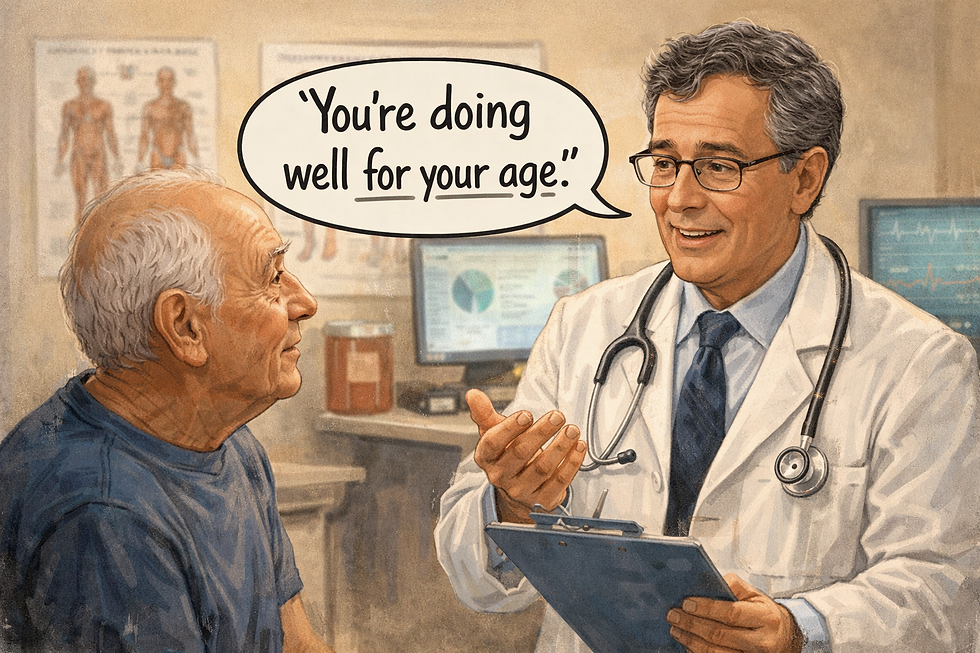
My doctor has never actually told me I’m doing well for my age, which makes me wonder if I should be concerned. I think I’m doing well. I pride myself on taking only two pills and still having all my original body parts. That seems respectable. But if no one in a white coat has officially confirmed it, am I grading on a curve?
From a purely statistical standpoint, I’ve already outlived my life expectancy. So technically, I’m doing great for my age simply by being here. By that measure, getting out of bed in the morning qualifies as an achievement. Everything else is just bonus material.
Not everyone objects to the phrase. A friend of mine says she’s perfectly happy when someone tells her she looks great for her age. “It makes me feel like I look younger than a lot of people my age,” she said. Fair enough.
Her husband, on the other hand, lamented, “No one has ever said that to me. I’d be delighted if someone told me I look good for my age.” Which just proves that, like most things, it depends on who’s hearing it—and maybe who isn’t.
Maybe saying someone looks good or is doing well for their age isn’t always such a bad thing. Intent matters, even if wording occasionally fumbles. And maybe part of the challenge is ours—deciding how much weight to give those three little words.
The next time I hear that phrase, I may take my friend’s advice—accept it as a compliment and let it brighten my day. And when it’s my turn to offer one, I’ll try to leave those three extra words unsaid.
After all, “You look good” is a perfectly complete sentence.
References
Regina Koepp PsyD, ABPP, 5 Ageist Things People Need to Stop Saying, PsychologyToday.com, January 1, 2024


Comments